
Choosing the Right Industrial Safety Sensors for Your Facility
Published on June 8, 2026
Navigate the complexities of selecting industrial safety sensors for your facility. This guide from Valley International Supply helps you understand different sensor types, key considerations, and how to integrate them with industrial control systems for optimal safety and efficiency.
In today’s manufacturing landscape, safety is not just a regulatory requirement; it’s a fundamental pillar of operational excellence. Protecting personnel, equipment, and production processes is paramount, and at the heart of this protection lies the effective implementation of industrial safety sensors. These critical components act as the eyes and ears of your facility, detecting potential hazards and triggering appropriate responses within your industrial control systems.
Choosing the right industrial safety sensors, however, can be a complex undertaking. With a vast array of technologies, standards, and application-specific considerations, making informed decisions is crucial. This comprehensive guide from Valley International Supply is designed to demystify the selection process, helping you identify the optimal safety sensor solutions for your unique facility and seamlessly integrate them with your industrial control systems.
We’ll explore the various types of safety sensors, delve into the key factors influencing your choices, and provide practical insights to ensure your facility remains safe, efficient, and compliant.
Understanding the Importance of Industrial Safety Sensors
Industrial safety sensors are more than just detection devices; they are integral to a proactive safety strategy. Their primary role is to monitor specific parameters within an industrial environment and, upon detecting an unsafe condition, communicate this information to an industrial control system (ICS). This communication then initiates a predefined safety action, such as shutting down machinery, activating alarms, or preventing access to hazardous areas.
Key benefits of robust industrial safety sensor implementation include:
- Personnel Protection: Preventing injuries and fatalities by detecting human presence in dangerous zones, monitoring hazardous conditions, and ensuring safe machine operation.
- Equipment Protection: Safeguarding valuable machinery from damage due to malfunctions, overloads, or improper operation.
- Process Integrity: Maintaining consistent production quality and preventing costly downtime caused by safety incidents.
- Regulatory Compliance: Meeting local and international safety standards and regulations, avoiding penalties and legal issues.
- Increased Productivity: By reducing accidents and downtime, a safe environment fosters greater employee confidence and operational efficiency.
Types of Industrial Safety Sensors and Their Applications
The world of industrial safety sensors is diverse, with each type designed to address specific hazards and operational needs. Understanding their principles and applications is the first step in making an informed choice.
1. Light Curtains and Grids
- Principle: These devices create an invisible curtain or grid of infrared light beams. When an object (like a hand or body part) breaks one or more beams, a safety signal is sent.
- Applications: Ideal for point-of-operation guarding on machinery like presses, robotic work cells, and assembly lines where frequent access is required but physical barriers are impractical. They prevent access to hazardous areas during machine operation.
- Integration with Industrial Control Systems: Light curtains typically connect to safety relays or safety PLCs (Programmable Logic Controllers) within the ICS. When a beam is broken, the safety PLC initiates a controlled stop of the hazardous motion.
2. Safety Mats and Edges
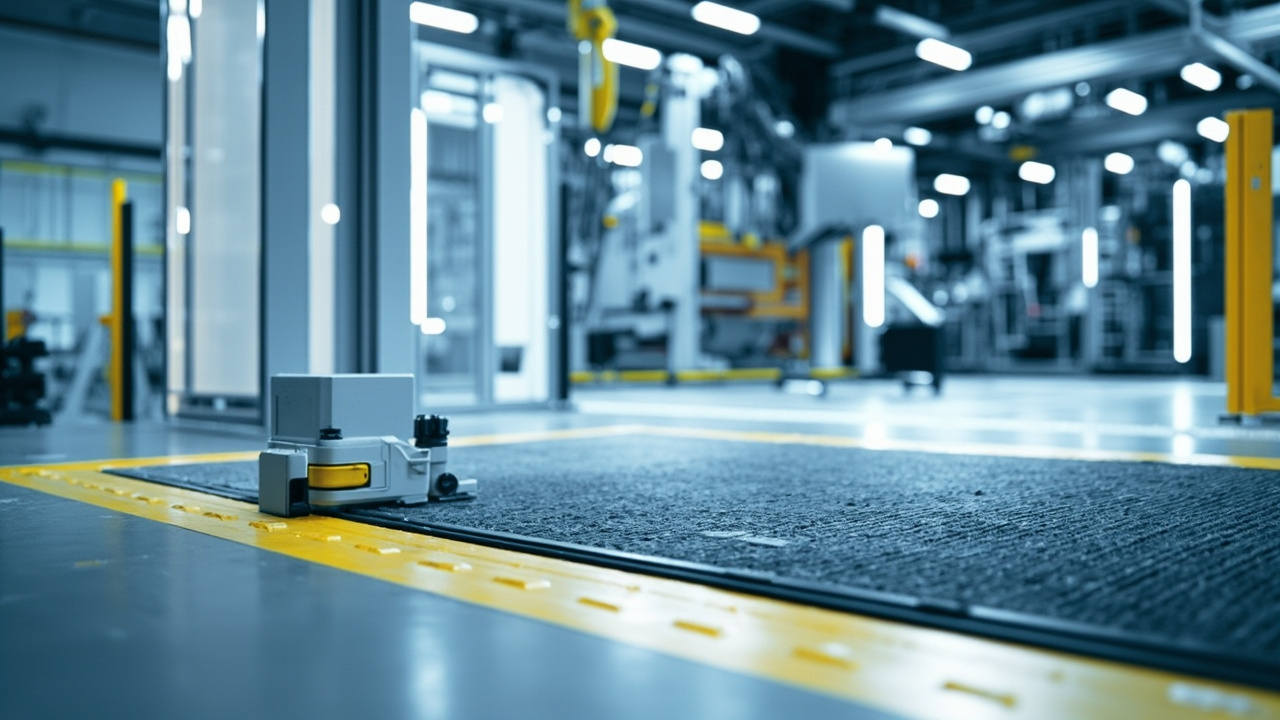
- Principle: Pressure-sensitive devices that detect the presence of a person or object when stepped on or pressed against. Safety mats are typically placed on the floor, while safety edges are mounted on moving parts or access gates.
- Applications: Used for area guarding around hazardous machinery, robotic cells, or automatic guided vehicles (AGVs). Safety edges are common on power-operated gates, doors, and machinery with crushing or shearing hazards.
- Integration with Industrial Control Systems: Similar to light curtains, safety mats and edges connect to safety relays or safety PLCs. Activation triggers a safety stop or prevents machine startup.
3. Interlock Switches (Guard Locking and Non-Contact)
- Principle: These switches monitor the position of machine guards, gates, or doors. They prevent machine operation if a guard is open or unlocked, and can also keep guards locked until a hazardous condition (e.g., machine coast-down) has ceased.
- Mechanical Interlocks: Rely on physical keys or cams to detect guard position.
- Magnetic/RFID Interlocks: Use magnetic fields or RFID technology for non-contact detection, offering higher tamper resistance and easier alignment.
- Applications: Essential for guarding access points to machinery, robotic cells, and hazardous process areas. They ensure that personnel cannot access dangerous moving parts while the machine is operating.
- Integration with Industrial Control Systems: Interlock switches are directly wired into the safety circuit of the ICS, often connected to safety relays or safety PLCs. If a guard is opened, the ICS receives a signal to halt machine operation.
4. Emergency Stop Devices (E-Stops)
- Principle: Manually actuated devices (buttons, pull cords) designed to immediately stop machinery or processes in an emergency situation. They are typically red with a yellow background and easily accessible.
- Applications: Required on virtually all industrial machinery and control panels, providing a readily available means for operators to prevent or mitigate an accident.
- Integration with Industrial Control Systems: E-stops are wired into the highest level of the safety circuit, often directly to safety relays or safety PLCs, ensuring an immediate and unconditional stop of hazardous motion, overriding all other controls.
5. Presence Sensing Devices (Proximity Sensors, Vision Systems)
- Principle: These sensors detect the presence or absence of objects without physical contact. While not always safety-rated, certain types are crucial for safety applications.
- Safety Proximity Sensors: Specifically designed and certified for safety functions, often used to detect the position of machine components or the presence of personnel in specific zones.
- Safety Vision Systems: Use cameras and image processing to monitor areas for human presence, detect intrusions, or verify safe conditions before machine operation.
- Applications: Safety proximity sensors can be used for end-of-travel detection, gate position monitoring, or ensuring tools are correctly seated. Safety vision systems are increasingly used in collaborative robotics, complex assembly lines, and large hazardous areas where traditional guarding is difficult.
- Integration with Industrial Control Systems: Safety-rated proximity sensors connect to safety inputs on PLCs or safety relays. Vision systems often have dedicated safety outputs that integrate with the safety PLC to trigger appropriate safety responses.
6. Two-Hand Control Devices
- Principle: Require an operator to simultaneously actuate two separate controls (e.g., pushbuttons) to initiate a hazardous machine cycle. This ensures the operator’s hands are safely away from the point of operation.
- Applications: Commonly used on presses, cutting machines, and other equipment where the operator’s hands could be at risk during the machine cycle.
- Integration with Industrial Control Systems: The two-hand control unit provides a safety output to the ICS (safety PLC or relay), which only allows the machine to cycle if both inputs are received within a specified time window.
Key Considerations for Choosing Industrial Safety Sensors
Selecting the right safety sensors goes beyond just knowing the types available. A thorough assessment of your facility, processes, and risks is essential.
1. Risk Assessment and Hazard Identification
- Foundation of Selection: Before considering any sensor, conduct a comprehensive risk assessment. Identify all potential hazards (mechanical, electrical, thermal, chemical, etc.), assess their severity, and determine the likelihood of occurrence.
- Regulatory Requirements: Understand and comply with relevant national and international safety standards (e.g., OSHA, ANSI, ISO, IEC). These standards often dictate the performance level (PL) or safety integrity level (SIL) required for safety functions.
2. Application-Specific Requirements
- Machine Type and Operation: Different machines present different hazards. A robotic cell requires different guarding than a hydraulic press or a conveyor system.
- Access Needs: How often do operators need to access the hazardous area? This influences choices between physical barriers, light curtains, or interlocks.
- Environment: Consider factors like dust, moisture, extreme temperatures, vibrations, and corrosive substances. Sensors must be rated for the operating environment.
- Response Time: For high-speed machinery, sensors with very fast response times are critical to ensure a timely stop before an incident occurs.
3. Performance Level (PL) and Safety Integrity Level (SIL)
- Quantifying Safety: These are measures of the reliability of safety-related parts of control systems. Your risk assessment will dictate the required PL (e.g., PLa to PLe) or SIL (e.g., SIL 1 to SIL 3).
- Sensor Certification: Ensure that the chosen sensors are certified to meet the required PL or SIL for your application. This is a critical aspect of compliance and effective safety.
4. Integration with Industrial Control Systems (ICS)
- Safety PLCs and Relays: Modern safety systems rely heavily on safety PLCs or dedicated safety relays. Sensors must be compatible with your existing or planned ICS architecture.
- Communication Protocols: Understand how sensors communicate with the control system (e.g., hardwired, safety fieldbus protocols like PROFINET/PROFIsafe, CIP Safety).
- Diagnostic Capabilities: Look for sensors with diagnostic features that can provide feedback on their status, identify faults, and simplify troubleshooting. This is crucial for maintaining system uptime and ensuring continuous safety.
- System Architecture: Consider whether a distributed or centralized safety control architecture is more suitable for your facility. Distributed systems can offer flexibility and reduce wiring, while centralized systems might be simpler for smaller applications.
5. Tamper Resistance and Bypass Prevention
- Human Element: Safety systems can be compromised if operators attempt to bypass them for convenience. Choose sensors and systems that are difficult to defeat.
- Design for Safety: Implement safety functions that are inherently difficult to bypass, and educate personnel on the importance of not tampering with safety devices.
6. Ease of Installation, Maintenance, and Calibration
- Installation Complexity: Consider the time and resources required for installation. Some sensors are simpler to integrate than others.
- Maintenance Requirements: Evaluate the sensor’s durability and maintenance schedule. Regular testing and calibration are often necessary to ensure continued performance.
- Troubleshooting: Sensors with clear indicators and diagnostic outputs can significantly reduce downtime during troubleshooting.
7. Cost-Effectiveness (Total Cost of Ownership)
- Initial Investment vs. Long-Term Value: While initial cost is a factor, consider the total cost of ownership, including installation, maintenance, potential downtime, and the cost of a potential accident.
- Efficiency Gains: A well-designed safety system can also contribute to efficiency by reducing accidents and improving operator confidence.
Integrating Safety Sensors with Industrial Control Systems
The effectiveness of your safety sensors is directly tied to their seamless integration with your industrial control systems. This integration ensures that detected hazards trigger the correct, timely, and safe response.
Key aspects of integration include:
- Safety PLCs (Programmable Logic Controllers): These specialized PLCs are designed to execute safety functions. They receive inputs from safety sensors and control safety outputs (e.g., motor contactors, hydraulic valves) to bring machinery to a safe state. They are programmed with safety logic and are certified for specific PL/SIL levels.
- Safety Relays: For simpler applications, safety relays provide a cost-effective solution for monitoring safety devices and initiating a safe stop. They are often used for single-function safety circuits like E-stops or guard interlocks.
- Safety Fieldbus Systems: For larger, more complex systems, safety fieldbus protocols (e.g., PROFINET/PROFIsafe, EtherCAT/FSoE, CIP Safety) allow safety-rated communication over standard industrial networks. This reduces wiring complexity and provides enhanced diagnostics.
- HMI/SCADA Integration: While not directly part of the safety circuit, integrating safety system status into your Human-Machine Interface (HMI) or Supervisory Control and Data Acquisition (SCADA) system provides operators and supervisors with real-time visibility into safety conditions, alarms, and system faults.
- Lockout/Tagout (LOTO) Procedures: Safety sensors are a critical part of preventing unexpected machine startup during maintenance. Proper LOTO procedures complement sensor-based safety by ensuring energy sources are isolated and locked out.
The Valley International Supply Advantage
At Valley International Supply, we understand the critical role that industrial safety sensors play in protecting your operations. As a trusted distributor and OEM representative for leading manufacturers like STEINEL, NOSHOK, DESCO, NORGREN, FASTEST, EATON, SIEMENS, and many more, we offer a comprehensive range of high-quality safety sensor solutions.
Our team of technical experts and project leaders possesses decades of experience in industrial automation. We don’t just sell products; we provide personalized service and tailored engineering recommendations to help you:
- Conduct thorough risk assessments.
- Select the most appropriate safety sensors for your specific applications.
- Design robust safety circuits that integrate seamlessly with your industrial control systems.
- Ensure compliance with relevant safety standards.
- Optimize your facility’s safety and operational efficiency.
We are committed to building long-term relationships by offering dependable support and expertise, helping you advance your manufacturing operations with confidence and peace of mind.
Next Steps: Securing Your Facility’s Future
Choosing the right industrial safety sensors is a strategic investment in your facility’s future. It requires careful consideration, expert knowledge, and a commitment to continuous improvement. By understanding the types of sensors available, assessing your specific needs, and focusing on seamless integration with your industrial control systems, you can create a safer, more productive, and compliant working environment.
Don’t leave safety to chance. Partner with Valley International Supply to leverage our expertise and access the industry’s leading safety solutions. Our team is ready to assist you in navigating the complexities of industrial safety and implementing a system that truly protects your most valuable assets.
Frequently Asked Questions
What’s the difference between a safety sensor and a regular sensor?
A safety sensor is specifically designed and certified to perform a safety function, meaning it’s built with redundancy, self-monitoring, and fault detection capabilities to ensure it operates reliably even in the presence of a fault. A regular sensor, while it might detect a condition, is not designed to the same rigorous standards for preventing harm and typically lacks the necessary certifications for safety-critical applications.
How do I know which safety performance level (PL) or safety integrity level (SIL) I need?
The required Performance Level (PL) or Safety Integrity Level (SIL) is determined by a thorough risk assessment of your machinery and processes. This assessment evaluates the severity of potential injury, the frequency and duration of exposure to the hazard, and the possibility of avoiding the hazard. Industry standards and regulations provide guidelines for mapping these factors to a specific PL or SIL requirement.
Can I integrate new safety sensors with my existing industrial control system?
Yes, in many cases, new safety sensors can be integrated with existing industrial control systems, especially if your system utilizes safety PLCs or dedicated safety relays. The compatibility will depend on the communication protocols and input/output requirements of both the sensors and your existing control system. Our technical experts can help assess your current setup and recommend compatible solutions.
How often should industrial safety sensors be inspected or tested?
The frequency of inspection and testing for industrial safety sensors depends on several factors, including the type of sensor, the application’s risk level, manufacturer recommendations, and regulatory requirements. Generally, safety systems should be regularly inspected and functionally tested at intervals specified in your facility’s maintenance schedule and risk assessment, often ranging from daily checks to annual validations, to ensure they remain operational and effective.
What are the most common mistakes when choosing safety sensors?
Common mistakes include underestimating the required safety performance level (PL/SIL), failing to conduct a comprehensive risk assessment, choosing sensors that are not robust enough for the operating environment, overlooking the importance of tamper resistance, and neglecting proper integration with the industrial control system. It’s crucial to consider the entire safety lifecycle, from design to maintenance.
Do I need a professional to help me select and install safety sensors?
While some basic safety sensor installations might be straightforward, for complex machinery or high-risk applications, it is highly recommended to consult with professionals. Experts can help conduct accurate risk assessments, select appropriate certified sensors, design compliant safety circuits, and ensure correct integration with your industrial control systems, ultimately providing a higher level of safety and compliance.